
.svg)
Building Scandinavian-Portuguese Technology Partnerships: A New Chapter at agap2IT
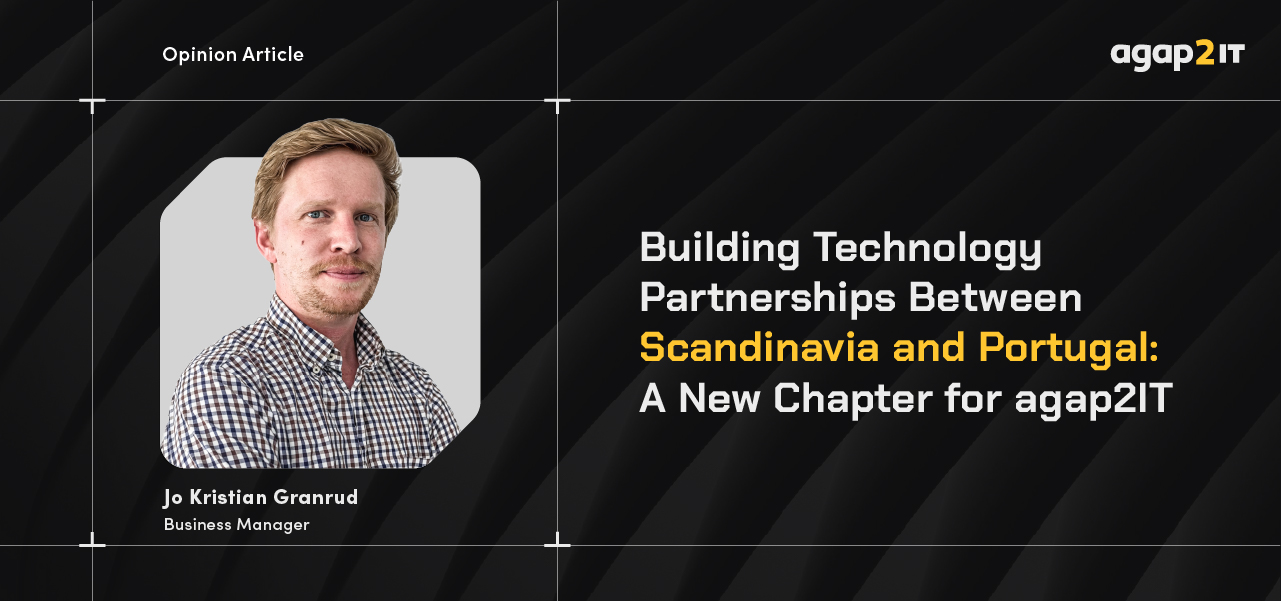
Across Scandinavia, technology demand continues to grow faster than the available talent pool. Companies are investing in digital transformation, cloud, cybersecurity, AI and automation, but many are running into the same constraint: they cannot find experienced IT professionals quickly enough to support their ambitions.
This is not a lack of demand. It is a lack of available talent.
In Norway, NITO’s 2025 ICT labour market report concludes that even after the number of ICT specialists has grown by around 40% since 2015, there will be a need for 12,000 more ICT specialists by 2030. In Denmark, that number is closer to 20 000. In Sweden, ManpowerGroup reports that 76% of companies struggle to find people with the right skills, with IT skills ranking as the greatest shortage area.
These numbers reflect what I have heard in conversations with Scandinavian companies: growth ambitions are there, projects are there, budgets are often there, but access to experienced technology talent remains a bottleneck.
That is one of the reasons I joined agap2IT.
Having worked with and around the Nordic market, I have seen how Scandinavian companies think about partnerships. Trust matters. Transparency matters. Quality matters. So does cultural fit. Companies are not simply looking for “more resources”; they are looking for reliable people who can understand their business, communicate clearly and contribute from day one.
When agap2IT asked me to help explore the Nordic market, I saw a strong opportunity to connect two regions that are highly complementary.
Portugal is, in my view, one of Europe’s most relevant technology partners for Scandinavian companies. It offers a strong base of engineering and IT talent, a mature international business environment, and a workforce that is used to operating across cultures and languages. Portugal also ranks among the very top countries globally for English proficiency; in the 2025 EF English Proficiency Index, Portugal is ranked 6th globally, ahead of Denmark and Sweden in the same ranking.
That matters.
For Scandinavian companies considering nearshore delivery, communication is often one of the biggest concerns. Will the team understand us? Will they be able to challenge us? Will collaboration feel natural? Portugal answers many of those questions well. It is in a compatible time zone, culturally close to Northern Europe, internationally oriented, and already home to a large number of multinational companies and technology operations.
The opportunity is not simply outsourcing. It is partnership.
Nearshore teams in Portugal can help Scandinavian companies access a broader talent pool while staying close in terms of geography, time zone, working culture and communication style. This can be especially valuable for companies that need to scale software development, strengthen data capabilities, build cloud or DevOps competence, increase cybersecurity capacity, or create stable long-term delivery teams.
At the same time, I believe there is an important cultural bridge to build.
Many Scandinavian companies are naturally cautious. They value control, predictability and long-term relationships. Looking outside the local labour market can feel like a big step, especially for companies that have not used nearshore or outsourced models before.
On the Portuguese side, I also see the opposite challenge. There is strong competence here, but Portugal has not always promoted itself as confidently as it should in the Nordic market. The talent, experience and delivery capability are already present. The next step is creating stronger visibility, trust and structured collaboration between the two regions.
That is where I see agap2IT playing an important role.
Agap2IT has built a strong reputation both as a technology partner and as a place to work. Internally, what stands out to me is the energy, competence and ambition of the organization. It is a dynamic environment with people who move quickly, but with purpose. That combination is important: speed without structure creates risk, but structure without speed limits progress. The best technology partners need both.
My vision for the new international area is to build long-term, trust-based partnerships between Scandinavian companies and Portuguese technology teams. Not transactional staffing. Not generic outsourcing. But practical, tailored collaboration models that help companies solve real capacity and competence challenges.
For some companies, that may mean individual consultants with specific expertise. For others, it may mean dedicated teams, managed delivery, or longer-term technology partnerships. The right model depends on the company’s maturity, internal capacity and strategic goals.
But the underlying question is the same:
How are you addressing the technology talent shortage in your organization?
If local hiring alone is not enough, it may be time to look at nearshoring as part of a broader talent strategy. Portugal is ready to contribute. Scandinavia has the demand. The opportunity now is to bridge the two in a way that is practical, transparent and built for long-term value.
At agap2IT, that is exactly the conversation we want to be part of.
conteúdos relacionados
Interesting Content
Contenu intéressant


-404
THINK2MORROW
UPDATES


.svg)





THINK2MORROW
UPDATES
THINK2MORROW
UPDATES