
.svg)
What if being different became the norm again?
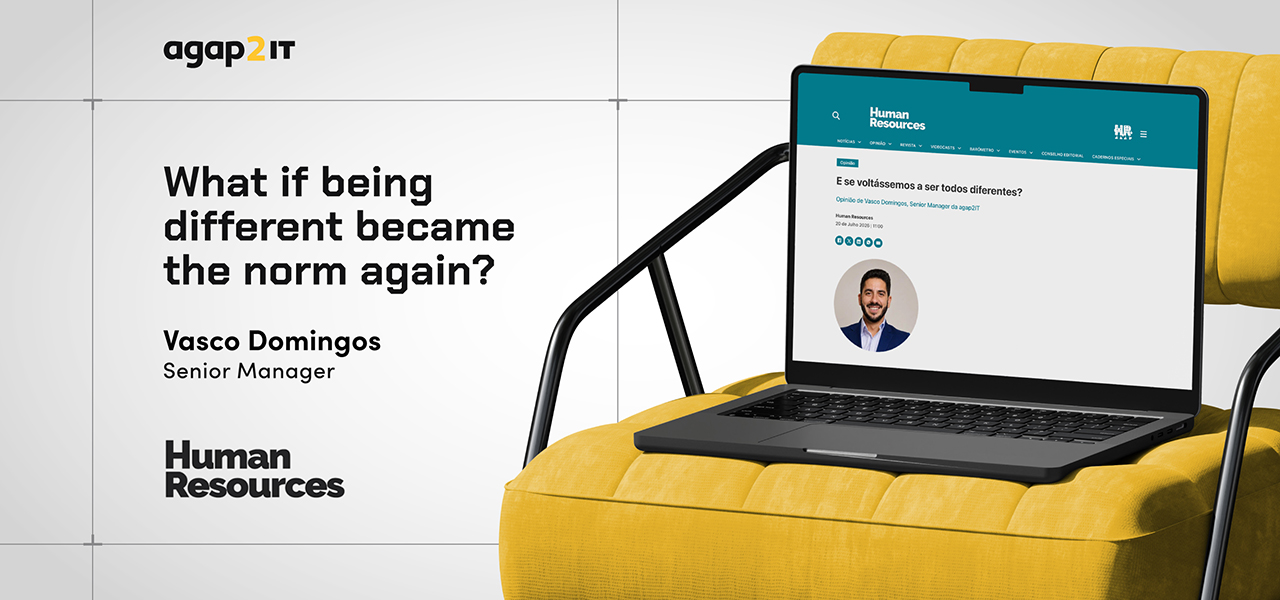
Vasco Domingos, Senior Manager at agap2IT, has written the opinion piece below for the online edition of Human Resources.
More and more, we find ourselves surrounded by automated processes.
We automate responses, proposals, presentations, messages, and even the way we communicate value to clients.
At first glance, this seems wonderful. And in many ways, it is. It makes us faster, more efficient, and more agile in responding to market demands. It allows us to achieve success with clients and prospects more quickly, structure solutions more effectively, and save time on processes that were once far more manual and time-consuming.
But there is a question that seems increasingly important to me: what if, amid so much automation, we all start to look the same?
What if the very things that differentiate us, the way we present value, interpret a need, or respond to a challenge, also become automated? What if the only difference between us and our competitors is the color of a document or the logo in the corner of a page?
Don't get me wrong. I use these tools too, and I believe in their value. We live in a world where responsiveness, efficiency, and the ability to deliver strong solutions quickly are highly relevant factors. Artificial intelligence and automation are here to stay, and ignoring them is not an option.
But just as I believe it is essential to use them, I also believe it is essential not to lose what remains deeply human: sensitivity, critical thinking, the ability to interpret contexts, understand people, and adapt messages to different realities.
Because, in the end, we are not simply responding to a procurement process, a human resources department, or a project opportunity. We are talking to people, people with challenges, expectations, pressures, goals, and different ways of seeing the world.
Technology can help us get there faster. But it is up to us to ensure that we get there differently.
Perhaps the real challenge is not to automate more.
Perhaps it is to use automation without losing our identity.
Because, in the end, it will not be the speed of our response that sets us apart. It will be the intention behind it, the attention to detail, and the ability to show that behind every solution, there is still thought, judgment, and people.
And perhaps that is precisely where we become different again.
Click here to read the article on Human Resources.
conteúdos relacionados
Interesting Content
Contenu intéressant


-404
THINK2MORROW
UPDATES


.svg)





THINK2MORROW
UPDATES
THINK2MORROW
UPDATES